How to organize a kitchen drawer for everyday cooking utensils
· Editorial team newsfromboston24.com
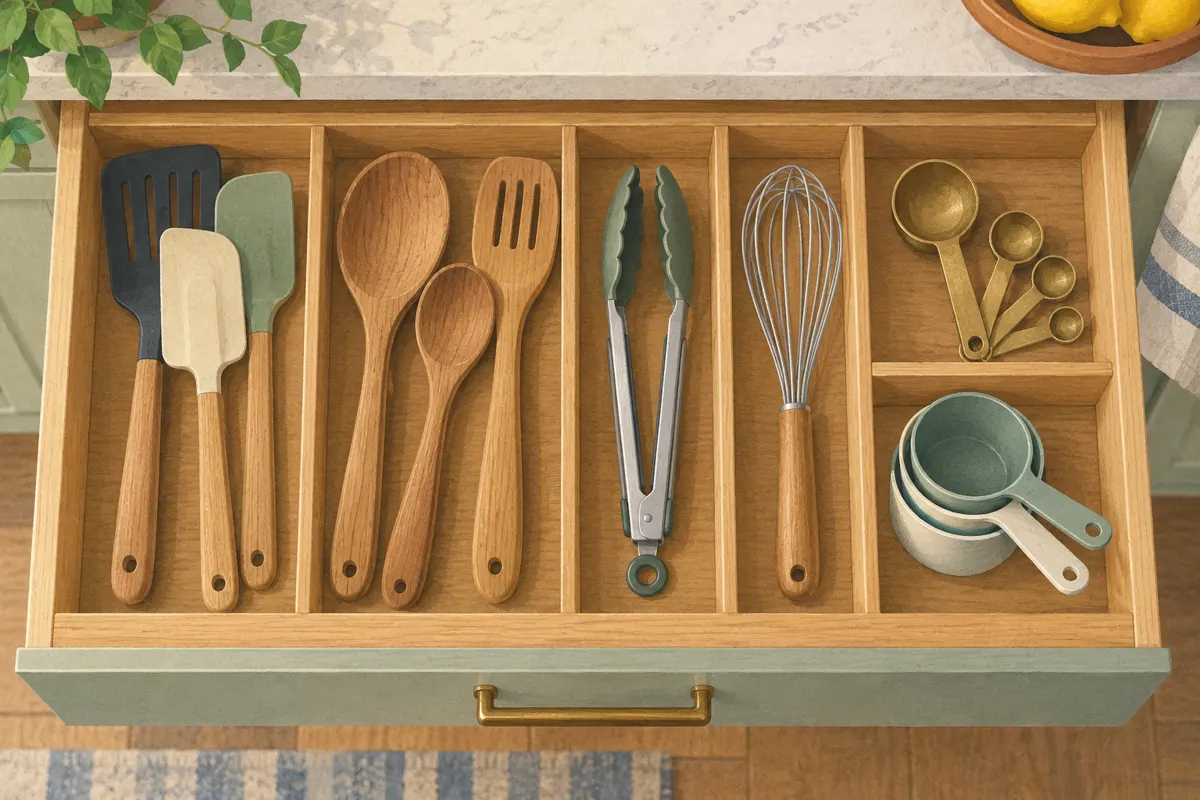
Organize your cooking utensil drawer by taking everything out, keeping the tools you regularly use, and grouping them in compartments that fit their size. Put your most-used utensils within easy reach, give small tools their own space, and leave enough room to lift each item without digging through a pile.
Empty the drawer and choose what belongs
Start with an empty drawer so you can see both the available space and the full collection of utensils. Wipe out crumbs and let the interior dry before putting anything back. Spread the tools on a clear counter instead of transferring the entire jumble straight into an organizer.
Our proposed starting point is to reserve this drawer for tools used during everyday meal preparation. Serving pieces, occasional baking tools, and gadgets you rarely reach for can go elsewhere. Keep useful duplicates: two spatulas may earn their space if you regularly use both while cooking. Remove extras that simply make the drawer harder to navigate.
- Keep here: tools you regularly use to prepare and cook meals.
- Move elsewhere: useful items for occasional tasks or serving.
- Pass along: clean, usable duplicates you no longer need.
- Discard: broken tools or items with damaged working parts.
Group utensils around the way you cook
Arrange the keepers by task before deciding on compartments. This gives you a practical starting layout: stirring spoons and spatulas together, tongs nearby, and smaller preparation tools in a separate area. Grouping by use helps you look in one place when you need a tool for a particular job.
Our proposed grouping is stirring and turning, gripping and lifting, preparation, and measuring. Adjust those categories to your meals. If you bake frequently, measuring spoons may deserve a prominent spot. If you mostly cook in a skillet, prioritize the turner and tongs. There is no need to give every category equal space.
Separate small tools from long utensils so they cannot disappear underneath them. Give peelers and fine graters a clear location where their working edges are visible; use their protective covers if supplied. The supplied Epicurious article also describes the difficulty of searching through mixed utensils with exposed sharp edges.
Fit dividers to the drawer and the tools
Measure the drawer’s usable interior width, depth, and height before choosing an organizer. Check the height available beneath the cabinet opening as well: a tool may fit inside the drawer but still catch when it closes. Measure your longest utensil and check the dimensions of individual compartments, not just the tray’s overall size.
Adjustable dividers or modular trays can accommodate a mixture of long handles, broad spatula heads, and bulky openers. Epicurious describes removable, interchangeable dividers as useful for changing a layout, while also noting that some fixed compartments and stacked designs did not suit the writer’s utensils.
- Long compartments hold utensils without forcing them diagonally across other groups.
- Wide compartments accommodate whisk heads, ladles, and tongs.
- Small compartments keep measuring spoons and compact tools visible.
- Dividers stay in place when you open and close the drawer.
- The organizer can be lifted out for cleaning.
Place everyday tools where you can reach them
Our proposed layout puts your most-used tools toward the front, with less-used pieces farther back. Lay long utensils in a consistent direction, with handles easy to grasp. Avoid deep stacks: if you must remove several tools to retrieve one, reduce the contents or widen that compartment.
- Place the longest and bulkiest utensils first.
- Position dividers around those tools without squeezing them.
- Add smaller tools to their own compartments.
- Lift out and replace each frequently used utensil to check access.
- Close the drawer gently and check for catching or shifting.
If the tray slides, consider a suitable nonslip liner or an organizer with nonslip feet. Epicurious identifies sliding trays as a problem with several organizers. Leave some open space rather than filling every gap with another gadget.
Make the arrangement easy to maintain
Return clean, dry utensils to the same compartments after washing. When adding a new tool, decide where it will live before putting it in the drawer. If its compartment is already crowded, reassess the contents instead of starting another layer.
After several cooking sessions, adjust any placement that feels awkward. Move a frequently used item forward, enlarge a cramped section, or relocate a tool you keep overlooking. The useful arrangement is the one that makes cooking and putting things away easier, even if the compartments are uneven.